
On Wednesday, March 11, all that ICE agents had planned for the morning was a traffic interdiction, which they anticipated would result in a swift arrest.
Three unmarked ICE vehicles boxed in their target in his car in the middle of morning rush hour traffic on Dorset Street in South Burlington. The man in the car veered to escape, driving over the median and colliding with an unrelated car in the opposing lane. The man then fled back to the small white house that ICE agents saw him emerge from earlier, 337 Dorset Street.
Soon afterward, both the South Burlington Police and Migrant Justice were made aware of the situation. Migrant Justice sent an alert out to its supporters to gather at the house. As many participants noted to the press that day, they weren’t protesters, but “protectors,” as the goal was not to register disapproval of a policy or law, but to protect their neighbors.
About a dozen federal officers present that morning were from a mix of agencies under the Department of Homeland Security, including Immigration and Customs Enforcement (ICE), Enforcement and Removal Operations (ERO, a subdivision of ICE), and, briefly, Customs and Border Patrol (CBP). Federal officers were woefully outnumbered by the crowd, quickly numbering over one hundred, that soon gathered to halt the ICE action.
ICE Officers Considered Canceling the Raid
Shortly after 9:00 a.m., the supervising ICE officer on site, David Johnston, exchanged a series of text messages that suggested ICE was considering abandoning its action on Dorset Street.
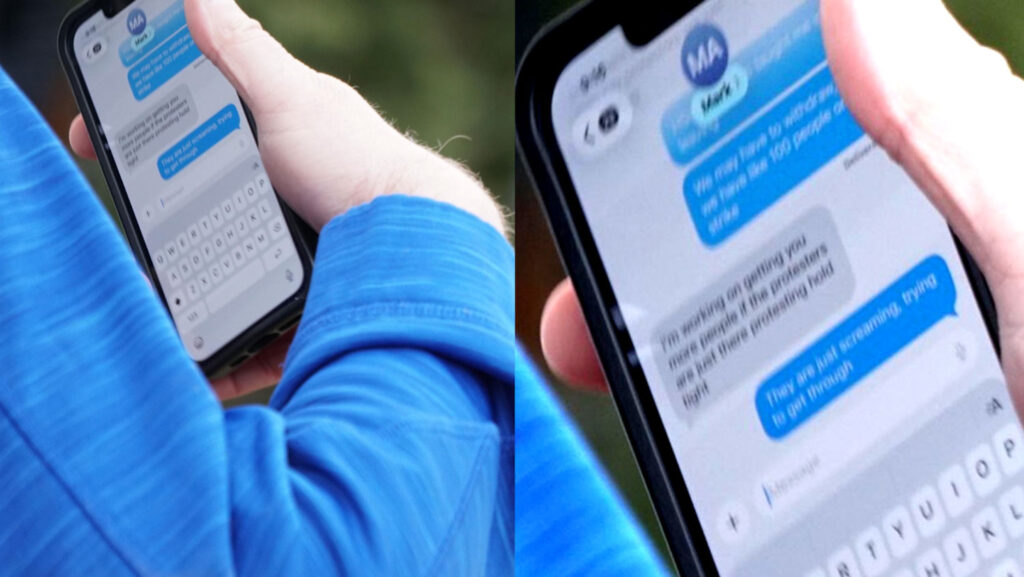
High-resolution photos taken of the officer’s phone and submitted anonymously to the Rake Vermont provide a glimpse into the deliberations taking place as federal agents attempted to pull in local and state police to assist them.
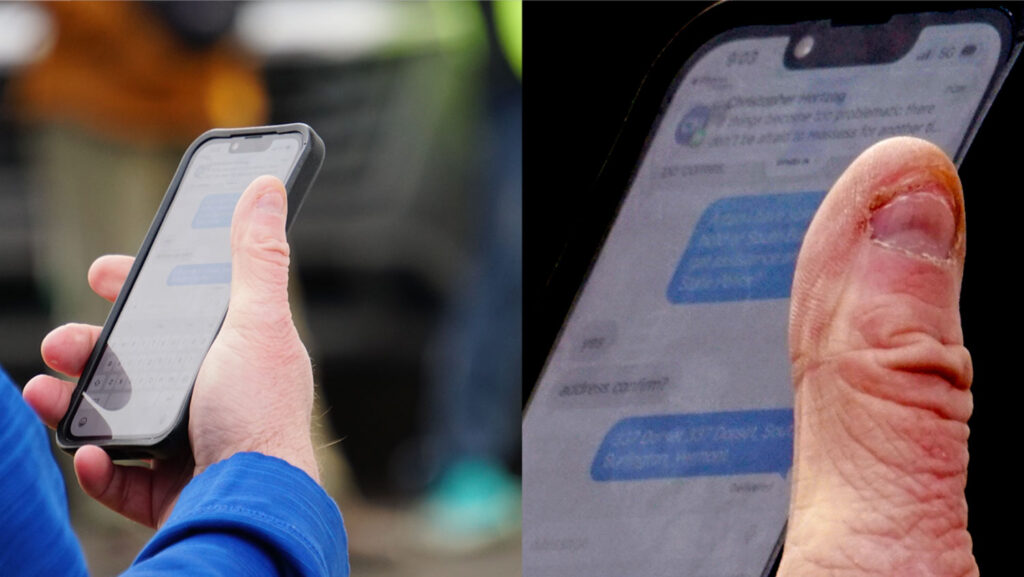
A message Johnston received reads from Christopher Herzog, a special agent with Homeland Security Investigations:
“If things become too problematic there don’t be afraid to reassess for another [time].”
Soon after, the officer searches for the phone number of Vermont State Police and dials it. About ten minutes later, the officer continues a text conversation with Mark Anzelmo, a supervisory officer with ICE’s Enforcement and Removal Operations (ERO):
Johnston: “We may have to withdraw, we have like 100 people on strike [likely he meant ‘site’]”
Anzelmo: “I’m working on getting you more people if the protesters are just there protesting hold tight”
Johnston: “They are just screaming, trying to get through”
Video footage captured by participants shows that at 10:45 a.m., Johnston told one of his fellow officers, “Just so you know, units are on their way, SRTs are on their way, stand by.” Fifteen minutes later, the officer then walked up to South Burlington Deputy Chief of Police Sean Briscoe and shared the same information, to which Briscoe replied by saying he was already aware. “SRT” is short for “Special Reaction Team,” a catch-all term that can refer to a number of specialized units within police agencies, including SWAT, anti-riot, and other mission-specific units that are considered riskier or require more training.
Around 12:30 p.m., two additional ICE officers from New Hampshire arrived. By this time, there were roughly 20 ICE officers on scene.
Around 2:00 p.m., Vermont State Police Lieutenant Cory Lozier, station commander of the Williston Barracks, addressed the group blocking the front door of the house. He warned them that more ICE officers were on their way and to move when requested. When someone said that state police didn’t have to help ICE, Lozier replied, “We still have to interject, it’s still the state of Vermont.” Another person said to him, “Fair and impartial policing? You don’t cooperate with them,” referring to the state’s Fair and Impartial Policing Policy. Lozier replied, “We have to when there’s a judge-ordered warrant.”
Neither of those statements by Lozier appear to be legally correct. The Anti-Commandeering Doctrine, rooted in the Tenth Amendment of the U.S. Constitution, prevents federal authorities from forcing local governments to carry out or enforce federal laws. In this case, the warrant was federal, based on violations of federal law. There are very few carve-outs to this doctrine. For example, in matters of federal immigration law, formal interagency cooperation like ICE’s 287(g) Program allows ICE officers to officially delegate federal enforcement tasks to state and local police. There are no active 287(g) programs within the state of Vermont.
Vermont State Police Escalate
The Rake Vermont interviewed a dozen Vermonters who were at Dorset Street. Participants in the house defense and blockade were unanimous in their assessments: the majority of violence inflicted on them was by Vermont State Police, Burlington Police, and South Burlington Police. Video footage widely shared on social media corroborates this conclusion.
After 4:00 p.m., about a dozen officers of Vermont State Police’s Critical Action Team (CAT), clad in masks and riot gear, and without nametags or badge numbers, were mustered further down Dorset Street in the parking lot of the University Mall. ICE officers were seen arriving and conferring with them. At 4:50 p.m., the criminal warrant ICE sought was granted by a federal judge.
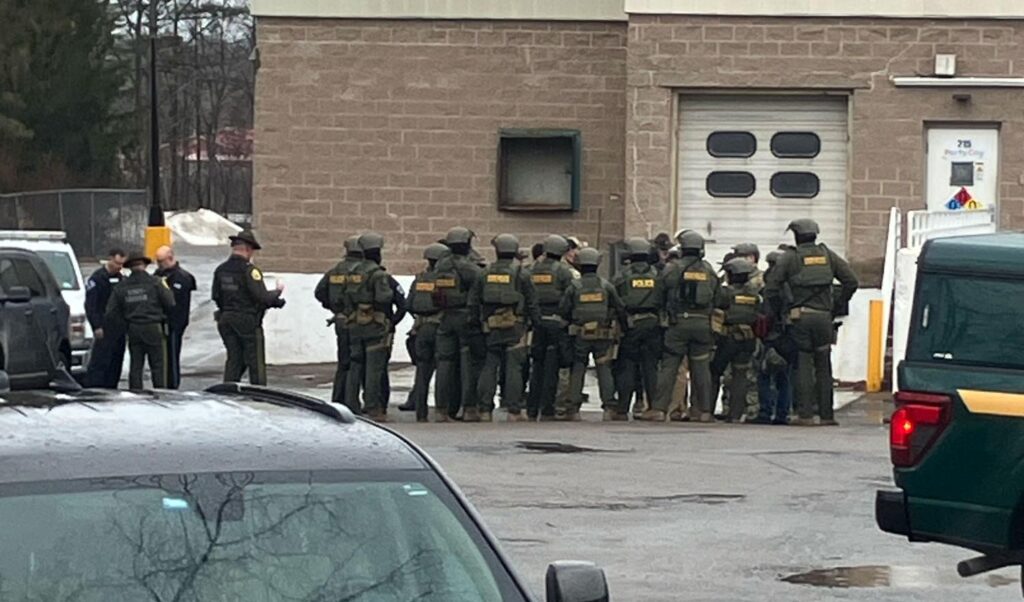
At 5:11 p.m., the assembled crowd outside the house was warned by ICE that the warrant was obtained and that they intended to enter the house.
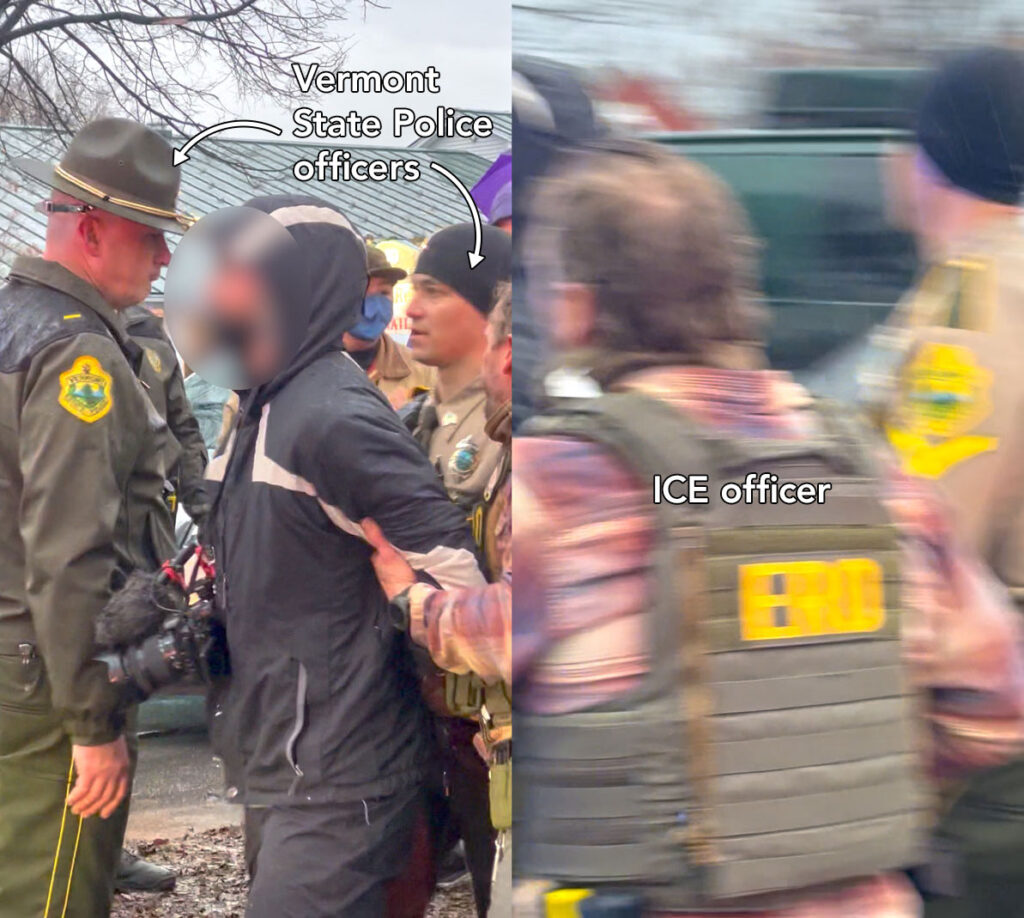
At 5:26 p.m., Vermont State Police CAT officers poured out of an unmarked black van and physically confronted the Vermonters protecting the entrance to the house, working with ICE officers to separate the crowd and physically wrench them away from the front door.
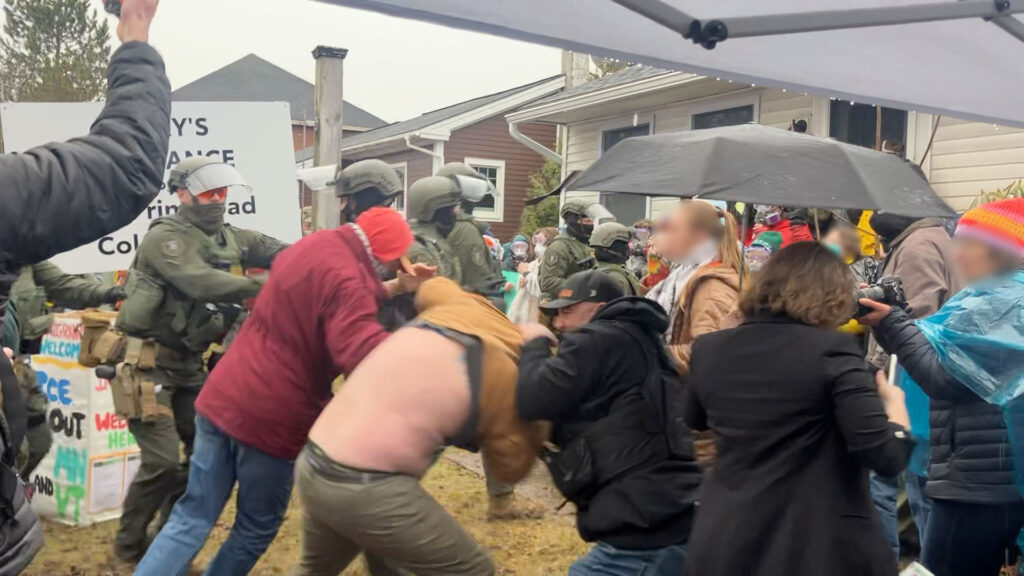
State and local police then formed protective walls to create a clear path through the crowd for ICE officers to break down the front door, enter the house, and then seize three of the four residents inside.
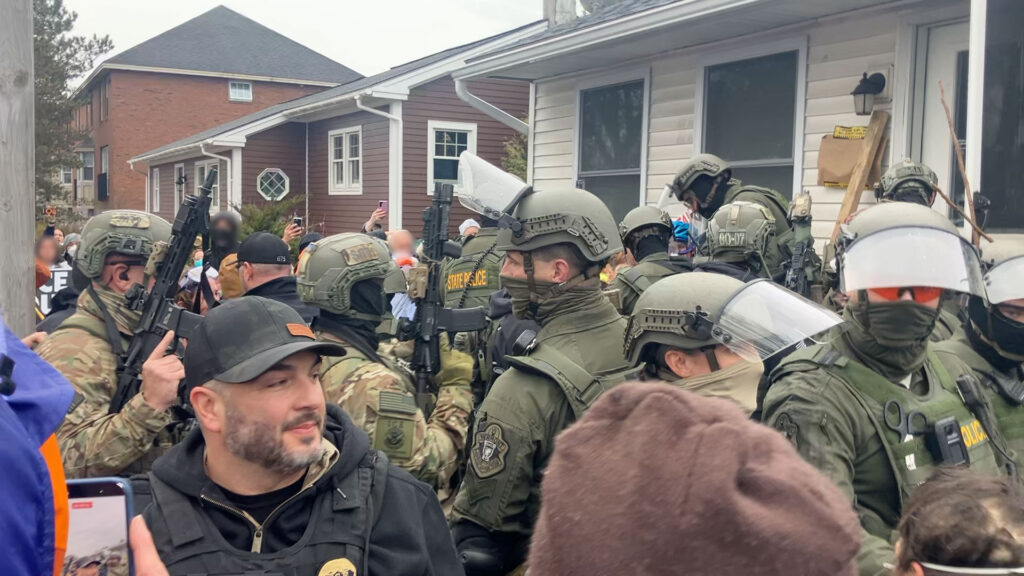
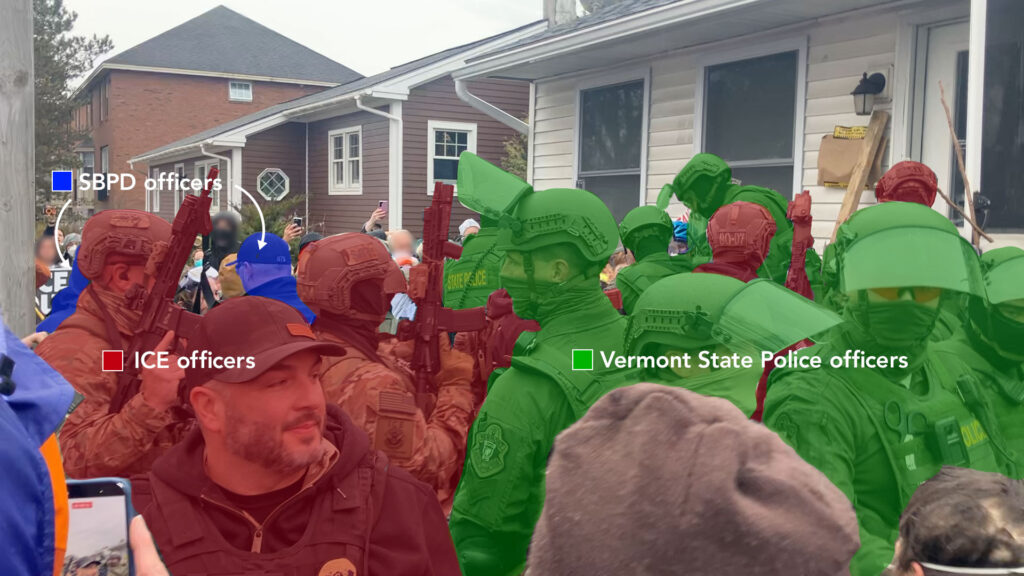
Even though none of the three people ICE pulled from the house were the individual named on the warrant, state and local police continued to assist ICE in removing them to the street.
Once the three residents were forcibly taken to waiting federal vehicles, the crowd quickly moved to block the vehicles’ departure by standing and linking arms, a common tactic that has been used across the country to halt, delay, or disrupt ICE operations.
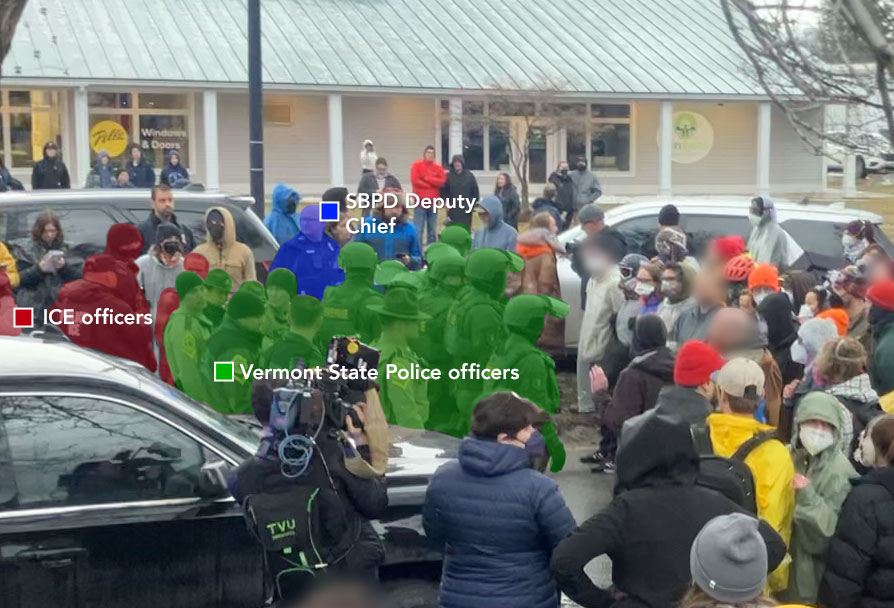
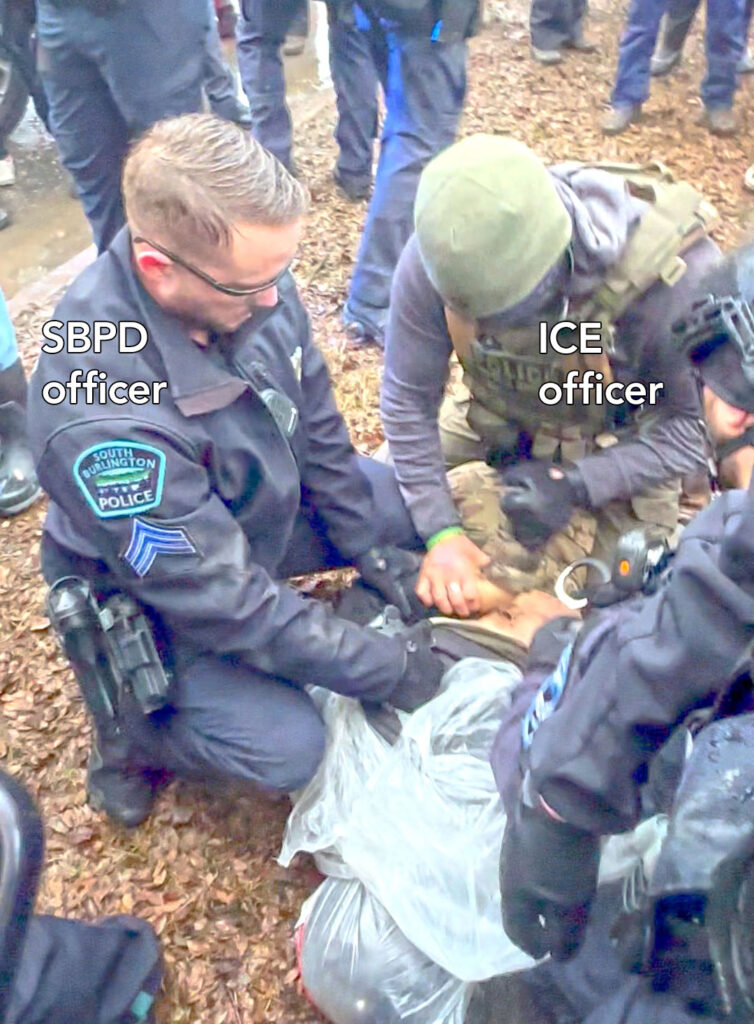
Vermont State Police formed protective lines around the cars, and then their CAT unit officers formed tight columns to push into the crowd. Video shows VSP officers dragging protectors from the crowd and passing them back to the waiting arms of ICE officers.
Variations on this dynamic played out over the next two hours, with ICE officers taking lead in escalating physical assaults on those attempting to block police vehicles. ICE agents doused Vermonters with pepper spray, shot pepperballs indiscriminately, and set off at least one pepper fog canister.
Would the ICE action have been possible without state and local police assistance?
According to a South Burlington Police statement that day, ICE officers contacted them around 8:45 a.m. for assistance in response to the growing crowd of Vermonters who had assembled to protect those inside the house. In addition, the release stated that “The South Burlington Police Department did not and [sic] assist federal agents with the enforcement of this federal immigration violation.”
A follow-up statement released the next day claimed that South Burlington Police Chief William Breault contacted federal officials “in an attempt to convince them to reconsider the need to execute the warrant in this manner and reduce the impact on the community.” According to the statement, the attempt was unsuccessful.
At Monday’s South Burlington City Council meeting, Breault said that he discussed with his officers “our duty to intervene and stop excessive force by other law enforcement,” and claimed that “local police would be there really to stop the limited number of ICE agents from using what I truly believe would be much more force, and we saw that later in the evening.”
That day on Dorset Street, the actions of South Burlington, Burlington, and Vermont State police did not prevent ICE violence. Instead, Vermonters witnessed violence by all four agencies.
Hand in Glove Cooperation
1. Collaboration with Homeland Security Investigations
Chief Breault consulted with DHS’ Homeland Security Investigations (HSI) at multiple points through the day, including to formulate a dispersal notice to the protectors. “Homeland Security Investigations worked with us, and we facilitated getting legal wording for a dispersal notice,” he told the South Burlington City Council on Monday. Contrary to Breault’s assertion to South Burlington City Council, HSI is not separate from ICE. HSI is a directorate under ICE and answers to the director of ICE. Notably, HSI agents arrested and tried to deport Vermont resident Mohsen Mahdawi in April 2025.
2. Joint Arrests
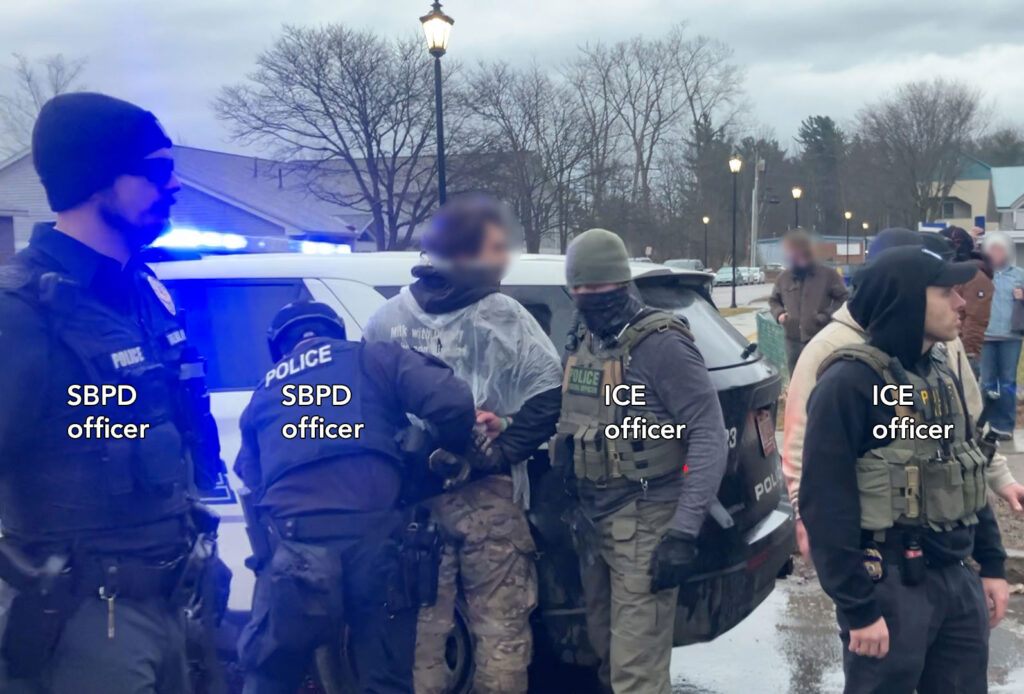
On multiple occasions, state and local police worked with ICE agents to detain and arrest protectors, as shown by photos and videos taken from Dorset Street that day.
3. Assistance in clearing and maintaining a path for ICE agents
Vermont State Police and South Burlington Police were observed leading the assault on Vermonters who were blocking access to the house. It was through that direct intervention that ICE agents could reach the front door and break it open.
4. Facilitation of ICE agents’ departure with three abductees
ICE agents entered the house with a warrant for one person. They left with three people, none of whom were on the warrant. State and local police went to great lengths to ensure an unimpeded departure by ICE agents and those they abducted, with local and state officers pushing and attacking those who stood or sat in the way of ICE vehicles. Any local or state officer with the ability to distinguish the numerical difference between one and three might have realized what they were, in fact, facilitating. SBPD Deputy Chief Briscoe was seen shoving people out of the way of the ICE car and holding the car door open for ICE agents to push the three people from the house inside the vehicle.
At the hands of ICE officers, Vermonters were beaten, thrown, pepper sprayed, shot with pepperballs, and choked with pepper spray fog. If South Burlington Police had a “duty to intervene and stop excessive force by other law enforcement,” either the department was incapable of fulfilling that duty, or they believed that ICE’s force was not excessive.
Kid Gloves with ICE, Fists with Vermonters
In addition to the many recorded instances of physical assault against the protectors by state and local police, some incidents match or go beyond what even ICE agents did that day.
Burlington Police Officer Julian Gonzalez is currently under a use-of-force review after recordings of him throwing multiple people to the ground.
A Vermont State Police officer, so far unidentified, is accused of choking one of the protectors to unconsciousness after threatening to break her fingers. The protector’s accusation, along with corroboration by two witnesses, including a nurse who examined her, was heard by the South Burlington City Council on Monday.
One of the several medics present that day spoke to the South Burlington City Council, stating that police reopened Dorset Street without warning while injured Vermonters remained on the street: “I looked to my right and I saw headlights. Not only had the police left us to care for ourselves, they had opened up the road to live traffic. With people in the street who were unable to see and were actively receiving medical care, there were incoming cars. […] Your claim is that you were there for the safety of others, but why did I find myself performing first aid in traffic? Not one minute later there were headlights at my back.”
Based on interviews and video review, the Rake Vermont found no recorded instances of Vermont State Police, South Burlington Police, or Burlington Police detaining ICE agents or physically blocking their actions.
Doing ICE’s Work for Them
It’s worth looking beyond official statements of intent, or pleas to worse counterfactuals, and look at what the community actually witnessed last Wednesday.
It was clear that local and state police would do nothing to directly rein in ICE behavior: to do so would be to invite a torrent of punitive federal legal action against them and their departments, as well as risk an immediate stand-off between two heavily armed groups of officers. But state and local police could rein in the behavior of their fellow Vermonters, the one group present that day that, without badges or guns, actually had a chance to halt the ICE operation. As a result, local and state police presence was not neutral, but in fact it necessarily pushed the scales in ICE’s favor.
State and local police actions made ICE’s work significantly easier. They blocked off traffic so ICE wouldn’t have to. They surveilled the crowd so ICE wouldn’t have to. They escorted ICE officers and vehicles so ICE wouldn’t have to. They kept protectors from de-arresting the abductees so ICE wouldn’t have to. They assaulted Vermonters so ICE wouldn’t have to. Thanks to what state and local police did, the ICE officers had effectively tripled their personnel strength on site.
Instead of suffering just at the hands of ICE officers, Vermonters suffered at the hands of ICE, South Burlington Police, Burlington Police, and Vermont State Police.
One South Burlington resident on Monday night’s city council meeting captured what appears to be a growing mood in the community:
“I’ve always had a relatively positive experience with officers in the past, and I was genuinely relieved in the beginning when I showed up around 9:00 in the morning. And by the time I left at 6:00 or so in the evening, I had lost all trust in armed officers.”
Patrick is a writer and organizer based in northern Vermont. He is on the editorial collective for The Rake Vermont.