Over the last two years, the Republican Party has continued its attack on America’s already fragile public health infrastructure, undermining public health policies and funding for vaccines, autism, maternal health, fluoride, and transgender healthcare, among its many targets. On July 24, 2025, Trump signed an executive order attacking homeless people and harm reduction policies. Almost one year later to the day, Burlington Democrats pushed through a Trumpian resolution of their own. With the support of powerful local business interests and a neoliberal-funded non-profit, their resolution, “Burlington Forward,” undermines safe consumption sites and syringe services in the downtown area while aligning with Trump’s rising health fascism agenda, furthering the erosion of public health in Vermont.
Federal Threats to Substance Use Funding
The Trump administration’s attacks on substance use funding have been relentless. In January, the administration threatened to defund substance use treatment, recovery, and mental health grants by $2 billion. While they temporarily backed down on these cuts, they still managed to sever $1 trillion from Medicaid funding, the main source of substance use funding nationally, and another $333 million for safe consumption and harm reduction programs.
Using the same playbook Republicans have used against grants aimed at supporting gender, sexuality, and racial diversity, in June, the Trump administration stopped funding grants that supported harm reduction. Trump’s 2027 budget continues this trend, further decapacitating substance use treatment and recovery funding by nearly $10 billion, including $3 billion to the Centers for Disease Control (CDC), and another $750 million to the Substance Abuse and Mental Health Services Administration (SAMHSA).
These cuts will severely undermine Vermont’s ability to support residents with substance use disorder, since nearly $60 million, or 70% of all substance use funding in the state, comes from the federal government. According to a 2025 presentation from the Vermont Department of Health’s Division of Substance Use, the state receives $17.5 million a year in federal funds, nearly 70% of which comes from the Administration for a Healthy America (formerly SAMHSA), plus another nearly $42 million in Medicaid funds. Only $5 million comes from state tax revenue, with another $20 million from special funds like the Opioid Settlement Fund.
Burlington Democrats Ignore the Violence of Homelessness While Fueling Stigma
Burlington Democrats and their boosters in the business community, including the nonprofit Building Burlington’s Future, seem completely unperturbed by the continuous and pervasive federal and local cuts to Vermont’s barely-existent social safety net while feeding into the growing stigma and dehumanization of homeless people and drug users. In their 21-page, 7,000-word Burlington Forward resolution, there is no mention of the federal cuts and further threats to Medicaid dollars, harm reduction, and substance use funding. It also makes no mention of the state’s defunding of motel vouchers or the Trump administration deprioritizing internationally recognized Housing First policies.
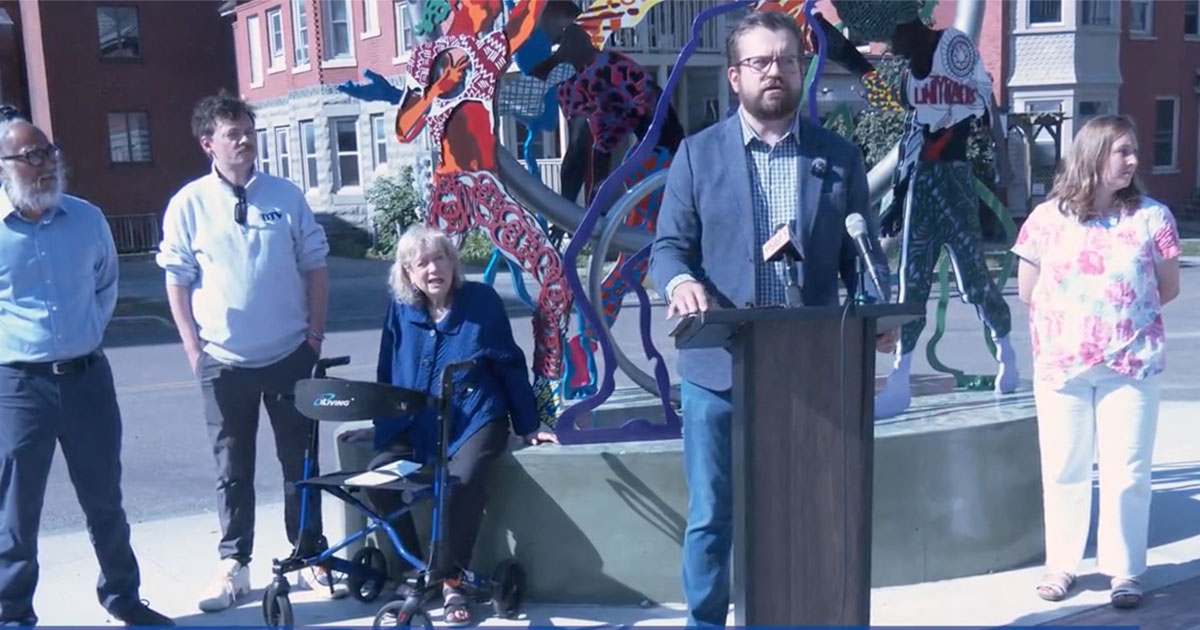
In a press conference for the Burlington Forward resolution, Ben Traverse, City Council President and potential mayoral challenger to Mayor Emma Mulvaney-Stanak, mentioned that the resolution is meant to restore the expectation that “everyone in Burlington feel safe.” He went on to single out the safety of children, families, downtown workers, and tourists. Missing from this statement, and only briefly mentioned in the resolution itself, were the people whose safety is most in danger: those who live on the street and are most likely to be harmed. According to Councilor Evan Litwin, Traverse was the primary author of the resolution.
In response, ACLU Vermont expressed its concerns about the language and framing in the Burlington Forward resolution, stating that “many of the policies at the heart of this proposal amplify rhetoric we see at a state and national level that depicts our struggling neighbors as somehow disposable and separate from our communities.” The organization highlighted how the resolution aligns with the far right by expanding law enforcement surveillance, deputizing civilian teams to conduct law enforcement, and vowing to displace vulnerable homeless people and send them to other communities by sweeping up the shelter and belongings of people with literally nowhere else to go.
An investigation last year by Seven Days found that 82 homeless people died between 2021 and 2024, found in “tents, sheds, motels, and dumpsters. The leading cause of death among them was accidental drug overdose.” Vermont’s 2025 Point-In-Time homeless count found nearly 3,400 homeless people in Vermont. This past winter, two homeless Vermonters died from exposure.
The Burlington Democrats’ resolution cannot be divorced from the stigma that “tough-on-crime” and War on Drugs language surrounding drug use and homelessness have created locally and nationally. Articles in national media organs that have moved increasingly to the right since 2016, like the New York Times and the Washington Post, have piled on this pro-fascist police and security state agenda by centering Burlington, a liberal city home to Bernie Sanders, as the focal point of the failures of progressive harm reduction and police accountability policies. In the same week that Traverse held his press conference, the Vermont Police Association called for the same racist and violent “broken windows” policing that the NYPD enacted in the 1990s. Recently, Governor Phil Scott’s administration installed bird-noise devices to deter unhoused people from taking shelter on the porches of the Vermont Department of Buildings and General Services in Montpelier, demonstrating that treating homeless people as inhuman and unworthy of dignity is a bipartisan policy position.
On top of all that, conservative, transphobic, and genocide-denier Michael Powell of The Atlantic featured Burlington in a hit piece in late July, repeating the tired and familiar fear-mongering about Burlington’s homeless population. Traverse had no problem joining in, claiming without evidence that, “It used to be that if you wanted to deal drugs, ‘you did not come to Burlington’… Open-air drug sales are a common occurrence here.” Aside from being a completely, and perhaps deliberately, preposterous statement, some well-known drug dealers who did, in fact, come to Burlington before 2020 to sell illicit drugs include former State Trooper Paul Lawrence, William Greer of Greer’s Laundry, and Ridin’ High skateshop owner John Van Hazinga. Other “open-air” drug sales take place in the many cannabis shops and bars operating in the downtown core.
In 2024, Traverse spoke to Fox News and fueled the far-right’s pro-police state narrative, stating that the city council has “really been working to support our police department…You know, we love our police here in Burlington.”
All seven Democratic city councilors were asked by email about the current substance use funding crisis and growing dehumanization of homeless people and those with substance use disorder. None responded to our questions.
Burlington Democrats Want Accountability for Everyone But Themselves and Their Allies
This convergence of national and local far-right politics has occurred under a torrent of Orwellian language. Phrases like “compassion fatigue” have broadened to apply to any housed person who no longer treats homeless people or those with substance use disorder with humanity, giving cover to dehumanizing, far-right policies that target some of Vermont’s most marginalized residents under the guise of “personal responsibility.” This Reaganesque rhetoric even found its way into the heart of the Burlington Democrats’ resolution, in which they argued that “compassion without accountability is not compassion.”
This is how you get public meetings of local business owners stigmatizing drug users, in which they use language reminiscent of the homophobic panic surrounding the 80s AIDS epidemic. At a city hall meeting at the end of August, Friendly Toast manager Todd Raymond said that he was recently stuck by a syringe, saying “…I used to be safe, I used to not have to worry about AIDS or hepatitis or any of that stuff, and now I’m having to get tested for this.”
This is how you get throwaway lines buried in WCAX crime panic news stories that reveal that there are local teens known to the homeless community as “bum hunters,” who wander downtown Burlington at night to harm people sleeping outside. While there is a special “accountability court” to coerce homeless drug users into treatment or prison, accountability for the business owners, journalists, landlords, and politicians who have made this state a nightmare for those without incomes or homes is nonexistent. Those who demand “accountability” actually mean punishment and discardment, but use that term to hide the stain on their own humanity.
The Democrats insist on accountability, but only for those in our communities who are most marginalized, impoverished, and oppressed. Landlords in Burlington are not held accountable for renting out slums or for leaving commercial properties downtown empty for years because they made poor business decisions. Burlington Police officers are not held accountable for assaulting Black children, shooting people in mental health crises, or assaulting people while assisting ICE in illegal arrests. Business owners are not held accountable for stealing wages from their workers (wage theft is the number one type of theft in the country) or engaging in illegal child labor practices. In fact, business owners and developers like Russ Scully, who engage in dubious practices, are rewarded with state loans for lucrative Burlington housing developments by the site of a former encampment for the homeless.
Burlington Democrats couldn’t even hold one of their own accountable, turning a blind eye to former City Council President Joan Shannon’s numerous conflicts of interest, including soliciting former police chief Jon Murad for a job for her daughter and profiting from the home sales of department heads, acting as their realtor before and after appointee votes.
According to filing documents from Building Burlington’s Future, the non-profit’s principal office was listed as a house owned by former Burlington City Councilor Joan Shannon, a landlord, realtor, and fierce opponent of the Vermont Progressive Party who lost her mayoral race against Emma Mulvaney-Stanak in 2024. The documents were filed in March 2025, two weeks before Shannon retired from the city council. Although the Burlington Business Association recently shuttered, the Lake Champlain Chamber of Commerce have launched a replacement “Downtown Business Alliance,” allowing the same handful of local millionaires to exert extra influence to push the same harmful policies and resolutions aimed at our most vulnerable residents.
Two of the organization’s seven board members, Michelle Asch and Ernie Pomerleau, are no strangers to undermining democracy and accountability for powerful community members who harm marginalized residents, while fueling anti-homeless screeds.
In 2022, Democrat and then-Mayor Miro Weinberger formed Burlingtonians for Responsible Police Oversight, another astroturfed campaign meant to undermine a ballot initiative to strengthen police oversight, after a string of Burlington police officers engaged in harassment and violence while facing zero consequences for their violent behavior. The political action committee raised $22,000 wholly from just five business and real estate families, with the incredibly wealthy Pomerleaus contributing nearly half of the total. Michelle Asch, the previous Burlington Police Commission chair and co-owner of Twincraft Skincare, donated $2,000 to ensure there was zero accountability for Burlington’s violent police department.
Building Burlington’s Future Tries to Play All Sides
Building Burlington’s Future is another way for Ashe, Pomerleau, and a handful of other business and political elites to undermine Burlington’s democratic processes, all while obscuring who the organization’s main funders (and agenda setters) actually are. It’s far from a new concept.
For their part, Building Burlington’s Future has taken positions boosting “law and order” policing and supporting the Burlington Police Department’s cushy recruitment efforts.
In an email to The Rake Vermont in early August, Building Burlington’s Future’s Executive Director Sam Donnelly acknowledged the Burlington Forward resolution put forth by council Democrats represented a false choice between compassion and public safety, and that the conversation shouldn’t be about making “one side good and one side bad.” Trying to straddle the fence of supporting neoliberal pro-police, tough-on-crime policies while publicly appearing progressive, it was unclear who, exactly, was represented in this hypothetical binary.
Donnelly would not comment on the record about any changes BBF might want to make to the resolution, nor would he comment on the public health, harm reduction, and substance use experts, if any, BBF consulted to inform their position on the resolution. Instead, on his own, he pressed The Rake to take the conversation about specifics off record and over the phone. We did not accept that offer and did not engage further after that correspondence.
Donnelly’s actions are typical and part of a growing playbook used by local politicians, business owners, and non-governmental organizations (NGOs) like Building Burlington’s Future, which are often funded by a small group of wealthy people and can exert tremendous influence over our local democracy. They often operate as a black box, wanting as little transparency as possible, by routinely asking residents or media organizations to “take the conversation offline” or demanding to speak off-record so they’re not subject to record requests or discovery during a future legal proceeding, and in many cases to quell dissent or to stop anyone from digging around into their work and poke holes in their motives and agenda.
Where Does Burlington Go From Here?
At a press conference hosted by VT Harm Reduction Advocates before the Burlington Forward resolution vote on August 3rd, Skylar Kelley, a nurse at Pathways Vermont, an organization that works with homeless residents, talked about how the resolution “without a doubt…will make it harder for people to access the care they need” and that the message is a dehumanizing one, which says “your presence is affecting commerce and the money we could make and we want you gone.” Kelley and other advocates called for a holistic and compassionate approach to community safety, stating that “to get a safer, more inviting downtown…we need to provide people with…housing, jobs, and care rooted in connection, choice, and community.”
In Vermont, there were 121 opioid related deaths in 2025, and 170 overdose deaths in total, a 25% drop from the previous year. These numbers are bound to go back up as the state refuses to fund motels for homeless people and the federal government cuts SNAP food benefits and substance use funding. Instead of working to fill in the growing material needs of our homeless neighbors, the local media, police, and business class will continue to fuel reactionary anti-homeless, crime, and addiction rhetoric. Burlington Democrats and their allies will continue to undermine centralized safe consumption sites and needle exchanges, while calling for homeless people to be forced out of the downtown core and scattered to less populated, wooded areas like the waterfront or Intervale.
Earlier this week, a revised resolution was announced and published online by the resolution’s supporters. Many of the changes made are nonbinding empty gestures toward “equity,” “culturally responsive” and “trauma-informed practices” or simply acknowledging work that is already ongoing.
The provisions with real teeth, like barring an overdose prevention center or syringe service program from operating in the Downtown Improvement District (DID), remain. The DID is functionally the entirety of the downtown, bordered on all sides by either residential neighborhoods or the lake. The DID encompasses the very aspects of the city that people looking for social services and assistance require, including: the downtown bus station, city hall, state and municipal offices, the main offices of the Howard Center, Spectrum Youth & Family Services Drop-in Center, multiple COTS locations, recovery center Turning Point Center of Chittenden County and River Rock Treatment, and the state and federal courthouses.
Democrats want to ban any overdose prevention center or syringe service program from the most accessible areas of Burlington, which would override medical and public health experts’ determinations of the most impactful and effective siting options. All the performative assurances they’ve added cannot paper over the fact that clearing away Burlington’s unhoused and in-need from the sight of the city’s business owners is the resolution’s priority, trumping all other considerations.
In a hallmark of the present neoliberal, carceral mindset of the Democrats, the resolution would also establish “Public Space Response Teams” that are given citation authority for a wide range of municipal infractions and power to “address and intercede conduct” but are envisioned to be staffed by volunteers, either city employees or “employees of other local organizations.” Those with nowhere to go, as they’re being ticketed and pushed yet somewhere else, will surely be relieved that Public Space Response Teams will have received training in “racial equity, implicit bias, de-escalation, disability awareness, trauma-informed practices, cultural responsiveness, and constitutional and civil rights protections.”
As this anti-harm reduction resolution works its way through City Council committees, residents who believe in the science of public health, who recognize that this targeted attack on homeless people and residents with substance use disorder is reinforcing the Trump administration’s fascist agenda, should be ready to organize and fight back. Fascism has long been creeping around Vermont’s door, and despite organized resistance to it from residents and activists over the last decade, plenty of others in the Vermont Democratic Party’s political and business class have happily welcomed it inside our house.
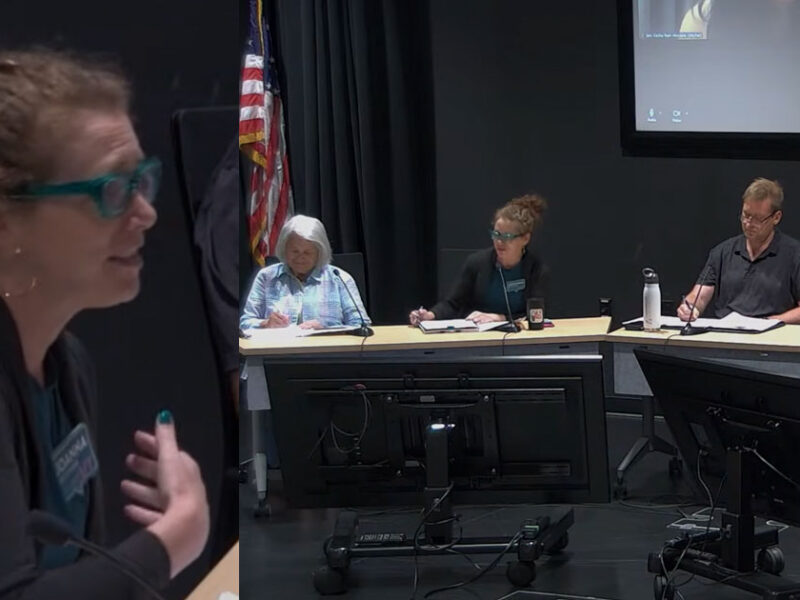
Photo at top courtesy Town Meeting TV.
Lia Fern is a Vermont resident who loves gardening.